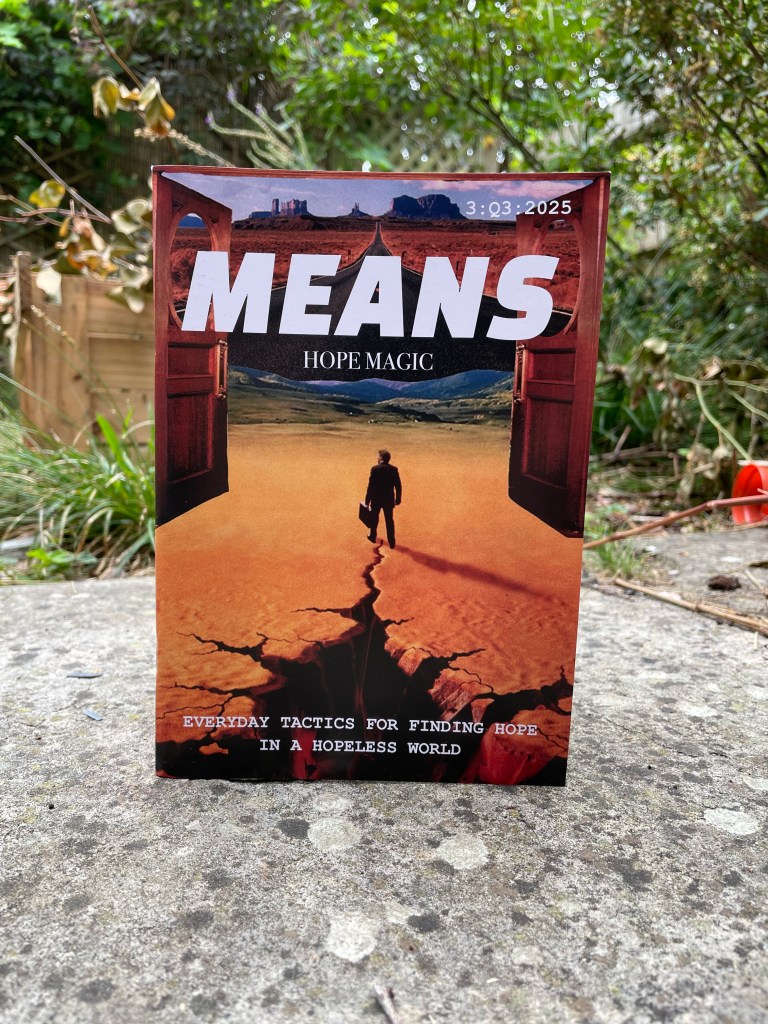
Issue 3 of MEANS is finally upon us, and it’s our best yet. After an expanded submissions process, we ended up sifting through nearly 100 works to bring you a wonderful overview of grassroots and experimental artists, writers and musicians working across the globe. The issue – themed around the relationship between Hope and Magic – draws upon painters working in war-torn Ukraine, striving to keep up their practice through literal blackouts. There’s discussions on the art of instrument-building as a method of renewing hope in a failing music industry, as well as a lovely interview with Harriett’s Press – a community launderette and art-workshop in Brighton. We’ve put together a range of artworks by some wonderful folk, all printed in high-quality full-color print. Please do check it out – we rely on your interest to keep the magazine afloat:
https://meansmag.bandcamp.com/merch/means-3-hope-magic
Although it feels a weird thing to brag about, remember – we don’t charge artists to submit, and pay a fee to all whose work is featured in the magazine, something that is sadly increasingly a rarity. By purchasing a magazine, you are directly financially supporting grassroots artists to carry on at a time where it is harder than ever to do so.
Over the coming weeks we’ll be showing a wide-range of artists on our website/substack, including some incredible stuff that we couldn’t, for one reason or another, fit in the magazine. In the meantime, check out a few short-reviews of some music that has sustained through this busy time….
Utero Dei
by Mondo Lava
(Hausu Mountain)
A superbly weird offering from Mondo Lava, Utero Dei is a fevered cultural montage, like someone heard about psych music but then immediately got distracted by a faulty VHS of old episodes of TOPT2 before they could really figure it out. Shapeless, distorted voices come and go, the remnants of entire songs, entire back catalogues drifting in and out of consciousness beneath a void of distortion. Songs start, slowly build into some semblance of structure, before collapsing into the modulating tail of gently-stroked delay pedal. With 75 minutes in play, it would be fair to describe this as ‘sprawling’, and it absolutely is – but not in the all too popular ‘could of cut a couple of tracks, couldn’t you mate?’ manner that many long albums exhibit, tailing off limply by their end. Utero Dei doesn’t have enough form to tail off – it’s more like the sonic equivalent of a hologram, where every tiny moment is an acute representation of the whole, tendered from a different angle.
Cue expansive synth solos, wayward percussion and erratic, borderline unpleasant organ stabs – the album brims, it boils, borrowing from the ‘everything all at once’ aesthetic of free-jazz without quite tripping into the same pretentious bucket, one finger cautiously wrapped about the rim, its raw intelligence nonetheless wryly smiling at the slightly slapstick. And whilst some tracks are a mite more cuddly than others – the warbling fx and occasionally cheesy synths trailing into the whimsical territory of Daphne Oram of Tod Dockstader – the sheer incongruity of its overall mood always negates the pleasant or the trite. Mondo Lava have created a whirlpool of rough edges, an album of background music for the sort of people who inhabit perpetually messy rooms.
Decadent Stress Chamber
by Giant Claw
Orange Milk
I’d be lying if I said I didn’t find this whole thing a little exhausting – a hyper-pop (although not, you know, Hyperpop) extravangaza of crashing drums, auto-tune, and arpeggiating synths, pinned together by glitching, weirdly drunken anthemic chorusses. Everything runs at light speed, an album that forcibly propels itself from one moment to another as if slightly afraid of stopping to catch its breath. A clear love for cheesy synthetic pop is married to a penchant for slightly off production choices – sounds that manage to be both over and under produced at the same time. It’s an approach that allows Giant Claw to move effortlessly between the more pop bits and the more industrial flavors – tracks like ‘Something to Believe in’ are wonderfully erratic, unable to entirely capitalize upon their BIG POP CHORUS in a manner that makes the whole thing far more alluring than it had any right to be. This aesthetic roughness works to push things past any sense of pure pastiche – even as the music itself clearly nods at its influences. Timbres bristle where you expect them to sheen, and, as if to underscore that this is all by design, the compositions themselves have a habit of suddenly punching out of their cage. The vocal-glitch, club-friendly house of ‘No Life’ is similarly executed halfway through – incongruous mallets morph into metal chugs and blast beats, as if someone has just opened the door to the Dragonforce gig downstairs.
Giant Claw asks a fair bit of the casual listener. It asks that you lean in to the rather unsubtle dollops of auto-tune; it asks that you stomach the ultra-compressed distorted guitars that sound all the world like the soundtrack to an early 90’s video game. It asks that you allow Decadent Stress Chamber to take you by the ears and drag you through a weird little garden full of mis-matched plants, none of which should probably grow in the same patch but somehow still do.
Singles and Outtakes 2007 – 2012
by Dear Landlord
After a somewhat tragic hiatus, one of the finest punk bands of the early 2000’s is back in action. For those who missed them the first time round – Dear Landlord where part of a scene of bands – alongside Off With Their Heads, Iron Chic and (perhaps more tangentially) Dillinger Four, that reinvigorated a slightly stale punk movement. Characterized by a gruff, depressed, mildly drunken approach to their three-chord craft, these bands were a welcome respite from the rather clinical family-friendly vibe of mainstream pop-punk, even as they worked with the same basic toolset. Dear Landlord managed to knock out just one album – the near faultless ‘Dream Homes’ before their singer was carted off to literal jail for his part in drug deal gone awry. It was an unfortunate turn of events that seemed all the more tragic for the underlying sense that, amongst a new millennium scene of disgruntled punks who were often living in the foreshadow of a global financial crash, their was a fair bit of drug experimentation and dubious life choices being made all round.
Tragedy aside, the band are back a decade and a half later, teasing a new album and offering up this wonderful collection of single and outtakes from their early years. Whilst a few of the tracks are marginally alternate takes from songs on ‘Dream Houses’ – namely the opener, ‘Three to the Beach’ and ‘Lake Ontario’, it is the array of less known b-sides that are the true gems here. The classic pop-punk of ‘Crashing’ is wonderfully insistent in its simplicity, and ‘Heartbroken Handshakes’ sounds like the epitome of a certain snotty, self-immolating punk spirit. Best of all, ‘A Little Left’ is a down-tempo, poorly-recorded masterpiece that manages to encapsulate the special nature of this sort of music – a genre that draws upon the same emotional pool as emo music, but with none of the pretentiousness: a genuine expression of life’s minor hardships.
Roto
by Derek Piotr
Derek Piotr conjures a heady breath of nothingness, a wonderful horizon of such minimal proportions it seems to quiver forever on the threshold of the perceptual and the imperceptual. Two 30 minute long tracks paint a vivid world of abstract murmurs, an intensely organic texture akin to lying in the desert of some distant European country surrounded by Cicadas. Latent ticks, the trill of some extremely distant trombone, sounds that merge into the hub-bub, less features than adornments to the meek, lethargic din. The first of the two tracks, ‘The Voice of Water’, migrates from the minimal to the absent over its extended run time, allowing the listener to drift, unprovoked, into a state of cautious bliss.
The B-side, “Lake of Sphinxes” takes this very quiet aesthetic (which is in fact the specific remit of the label involved, ‘Discreet Archive’) and does… well, very little with it, which is of course the point. A more obvious dark-ambient vibe is present, with some ominous electric clicks and glitches interfering with some far-off nymphs woodwind practice. One of the remarkable things about Piotr’s work here, is that there is very little sense of development, yet things don’t really remain static either. Sounds come and go, bringing with them new moods, new vantages by which to reflect on the pieces as a whole. And yet, none of this really feels like structure – its positions are always different yet familiar, alternate shades of the same dimly painted wall.


 MEANS
MEANS 