The making of the album with Ukrainian poets
“Chimerical twenties” – new light bearers
will say about us one day in this very living room.
Hello, we melted as butter in porridge,
but in your memory we were as if made of steel.
Read the past by the Braille stars:
We built the house — you must keep the walls.
‘The Braille Stars’ by Olena Halunets
Being a lifelong pacifist and taking refuge in Buddhism in my fifties, I happily accepted the opportunity to provide some music for the project Yellow and Blue Through Black and Gray. I think that turning war into art is a revolutionary act of the highest order. I love to see our human spirit shining through the clouds, spouting the politics of love and rebelling in the face of hatred and ignorance.
James Schlesselman, musician (USA)
1. WATERFALL FROM OUR TONGUES
My first attempts to immerse myself in the Ukrainian language date back to January 2023. Until that moment, I got along fine without it: everyday bilingualism in Kyiv was the order of the day, and I didn’t feel much incentive to leave my comfort zone. Everyone speaks as it suits them, everyone understands everyone. The war shook this bilingualism, but did not overthrow it – at least in the capital. And it would be possible to live as before without big problems – but something was already in the way. And this is unlikely to be due to the obsessive calls to get rid of the language of the occupiers, which were pushing in the opposite direction. This was the moment when even the most amorphous characters like me had to not only decide whether they belonged to this side or that side – such a question was not even raised – but to find this belonging within themselves. To feel where it lies, what it looks like, what it is based on. Or grow it.
Learning a language from modern poetry is, to put it mildly, not an obvious solution. But it is quite possible to search for this belonging. Winding through the nooks and crannies of meaning and dissolving in ambiguity. Trying to feel the rhythm, even if it wasn’t originally put there. And finally, catching the music in these poems: both in the lines themselves and in the pauses between them.
Actually, that’s how this idea came about. Of course, no one canceled the courses and textbooks: no matter how boring they were, it works, but I needed my own action in order to appropriate this language, to let not so much it into myself as myself into it. And the idea was not long in coming – although it took some time to believe that it was feasible.
So I beg you:
Don’t rush, your vigilance will quickly drown
in streams and crowds, and only a moan
will echo to remind you, my friend,
that you failed.
‘taenaet’ by Maxym Churkov

There were more than enough musicians around who could cope with this task. Around means not in Ukraine, where I’m kinda recluse, but in the virtual Ambient and Experimental Music Community, where I have been active for three years, almost from the moment of its foundation. As for familiar Ukrainian-language poets, alas, their number did not exceed zero. So I didn’t even try to look for them. It turned out to be easier to find someone who would find them. This is how Pasha Broskii, the admin of the telegram channel called Modern Ukrainian Poetry (Сучасна Українська Поезія) and the organizer of countless poetry readings, appeared on the stage. The idea now has a second leg and the ability to move. Stumbling, hobbling, falling, freezing for an indefinite time – but still move!
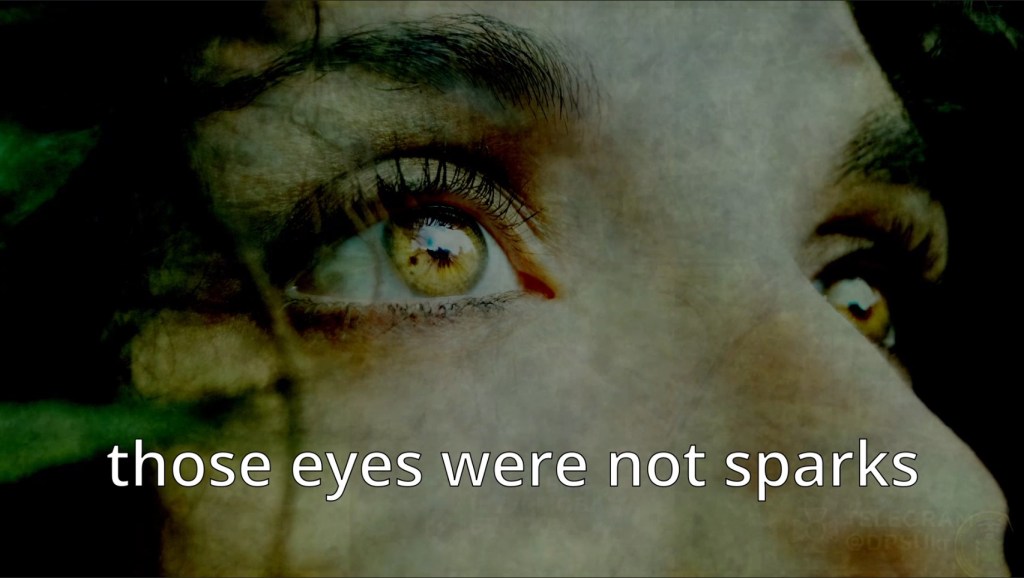
those eyes were not sparks
they were meteors
they were burning with the realization of the impossibility of depoetizing
every soul that dreams with a pen or at least a keyboard with notes in
the phone
they were meteors with a temperature of millions of degrees Celsius
so that we can turn the wine to gluhwein in all the vineyards of the world
‘we were the men in black ‘ by Vlad Kovbasiuk
At the time I received the first verses, I understood approximately 50% of the words they consisted of. The online translator brought this figure to almost 100, but some texts did not become any more understandable. A year and a half later, I can explain every line – although I can’t promise that my interpretation will coincide with the author’s.
The differences between languages is fascinating, and as I worked through the poems I became very aware of the ways in which geography, landscape and culture influence language, and how language itself affects the way that people think about the world.
Add to this the fact that poetry uses language rather differently than speech or prose. For example, when I thought a poet was using imagery, they were sometimes being quite literal. Or vice versa.
Guy Richardson, musician and translation editor (UK)
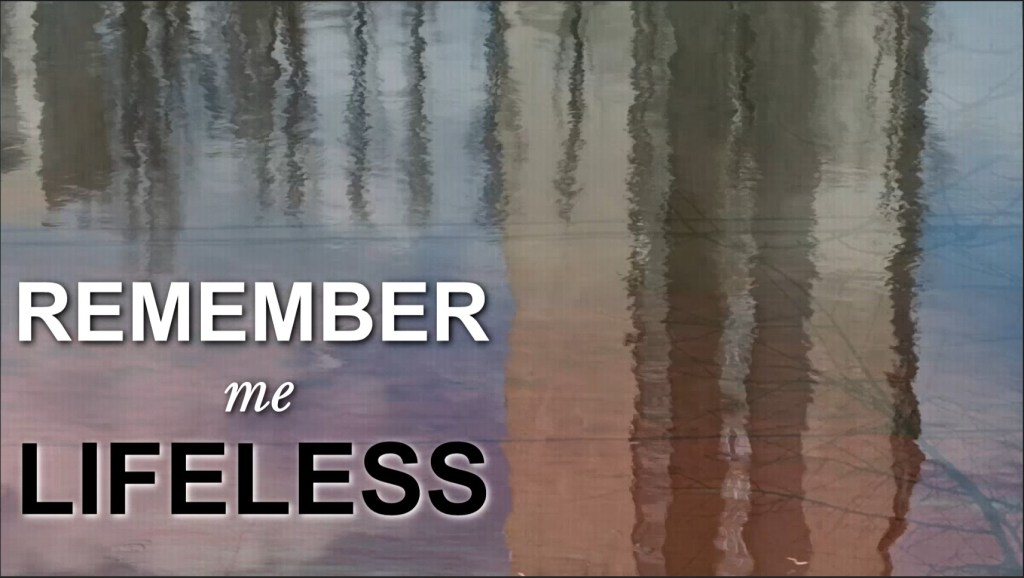
I remember how we struggled with an adequate translation of the expression “glass happiness” from Maxym’s poem. How can I convey in a nutshell that windows are the most vulnerable part of the wall, and that if “russian roulette” points at you, even if you don’t end up under the rubble, at best you will have to powder yourself with small fragments of glass. Try to separate the literal and metaphorical in these lines:
Ignoring omens,
Don’t stand by windows, oblivious to glass,
it often happens:
at first,
fragments of hopes
burst into the house like hell,
split the walls and seventh heaven,
pass through the heart with the gleam of a coin,
getting stuck with a coppery gaze in the eye sockets.
‘taenet’ by Maxym Churkov
Poets are quite difficult people. They are too vulnerable, too sensitive, they live in some dimension of their own with their own rules and laws of physics that are beyond the understanding of ordinary mortals. They can build steel walls with rhymes and metaphors, but one wrong word that does not fit into the paradigm of their microcosm, and the wall, no matter how strong steel it is made of, crumbles to dust.
Pasha Broskii, literary curator of the project
Working with poets was a lot of stress. At times I felt like a guest animator who, instead of toddlers, found mature graduates who had no intention of jumping in sacks. There was a moment when three of them suddenly refused to participate in the project, despite the fact that the compositions with their poems were already ready. I still wonder where the words came from that convinced them to change their minds.
we loved this world through the prism of all the meanings of the word ‘poet’
we love this absolutely cursed but no less attractive poetry
which flowed like a waterfall from our tongues
and flowed without even making the paper wet
making wet only women who listened to everything written above.
‘we were the men in black’ by Vlad Kovbasiuk
2. TEXTS, UNDERTEXTS AND OVERTEXTS
In this regard, a short sociological observation would be appropriate. The main and most active contingent of musicians in the project are people over sixty. The oldest, James Schlesselman, is 74. Many have 30-50 years of musical experience behind them, which, however, has not made them particularly famous – with the possible exception of Phil Durrant, well known to connoisseurs of the London avant-garde.
The contingent of poets is almost entirely young people under 30. The youngest, Vlad Kovbasyuk, was 20 at the time of recording; now he is fighting on the front line. Many can boast of winning competitions, battles, awards, and a couple of authors have a published book to their credit. There is an exception here too – Oleh Ladyzhensky is well known as half of the writing duo Henry Lion Oldie, an author of more than fifty novels in the spirit of philosophical fantasy. Oleh is not connected in any way with Modern Ukrainian Poetry; I plucked up the courage to invite him myself.
The cat watches the pigeon
The pigeon studies the crumbs,
Everything is not as it should be
The world must pack up and go
Every day, every moment
It burns and hurts.
It may or may not be
Something to remember or forget?
For someone, today will be their last
The bullet-viper will sum up our whole lives
And something will be put aside for memories.
‘Evening Glow Milk’ by Oleh Ladyzhensky
It is worth adding that these lines were written in the city of Kharkiv, half destroyed and constantly under fire.
However, even among poets, success is understood differently. Here, for example, is a wonderful summary that I love to re-read.
I’m Snig na Golovu (‘Like Snow on the Head’ is our analogue to English ‘Out of the Blue’), but actually Natalya in everyday life. Lviv based woman, wife and mother.
I write texts, undertexts and overtexts, and if in an understandable language – rhyming works and vers libres. I don’t consider myself a poet, rather, a philosophing graphomaniac who sometimes needs to say something “out loud”. Firmly convinced that without my texts the world won’t lose anything and won’t become worse. Not ambitious. Didn’t publish anything, didn’t submit anything to competitions, didn’t receive any awards or honors.
I adore rocks, mountains, stones and, of course, winter.
Snig na Golovu, poetess.
Now evaluate the level of graphomania:
I was faithful to that torture and
suffered alone, keeping away from those,
who could catch this evil from me,
that was eating me quietly.
аnd my hunger grew, or rather, satiety,
which there was no one to share with.
‘Rapids of Hunger’ by Snig na Golovu
These were the poems about love. War is war, but the theme of love prevails in our selection. Maybe because most of the poets are women? (Perhaps this is not particularly noticeable in this text. But this is for now). While there are only three women among the musicians, two of them perform in duets with men, and the third prefers the pronoun “they”. In AEMC, there are catastrophically few women in general – one might say, they are worth their weight in gold. Here’s another sociological thorn in your head. Personally, I am very pleased with the fact that it was the female tandem Jennifer Howd / Ada Yelagina that was selected for the Late Junction show on Radio BBC 3. The presenter equated Ada’s deep, thoroughly authentic voice with lament.
I am so tenderly quiet and pale.
I’m lying on the ground, so that my lips are barely moving.
I waver like the ears of grass;
the herbs are my breath.
the stems in my chest are bursting my bones,
exploding with cherry groves and wild plums,
and your face in the colors of green
dimly appears
and softly calls.
shall I sleep tickled to death?
or did this feather grass become me?
it mesmerizes and whispers
in the endless surf of virgin plains.
oh my white field – you`re like a ruin
unwedded and sleepless.
I lay down, but you say that I can’t yet
and the ground takes the bullet.
‘The Bullet’ by Ada Yelagina
Who knew that my voice, recorded one restless night on a telephone recorder, would one day reach Britain?
Ada Yelagina, poetess
Indeed, they recorded, some in a reputable studio, and some in a wardrobe or under a blanket. At the output, these details are practically indistinguishable.
3. THIS PASSIONATE PLEASURE
mockART joined our project later in the process. We had two poems by Maksym Churkov to choose from and ultimately selected Tænæt. Its sinister undertones and the captivating way Churkov recited it resonated with us. Our experience with setting poetry to music made this particular piece easier to work with, as we focused on amplifying the poem’s inherent tone of voice.
Rabirius, musician (GER)
On the very pleasant part of the work, I have listened to the poem probably a hundred of times, and it was each time a repeated pleasure to hear those words that I don’t understand but pronounced with a voice that can convey so much meaning beyond the words.
Stephane Wandezande aka Whispered (BEL)
In fact, all the musicians were familiar with the translation from the very beginning; they chose poems based on the voice recording and translation. Those who wished could receive a line-by-line timeline, which indicated the start time of each line. True, the lines of the translation and the original often did not coincide: the Ukrainian language allows much more liberties in the order of words than English, and the length of sentences was limited, apparently, only by the amount of air in the author’s lungs 🙂
Most of the musicians actively communicated with each other in a special closed group, sharing drafts, advice, ideas and support. That’s why I cringe every time our album is called a compilation (even if sometimes I have to do it myself, for the sake of brevity). These are not just selected tracks from different authors; it is a conceptual program created collectively in real time, with the end result in mind. Although the result still ended up surprising many authors.
Communication between musicians and poets was deliberately blocked. If necessary, the former could, through my mediation, receive clarification on the text, but direct communication was excluded so that the poets could not influence the music with their ideas and preferences. The musicians were focused not so much on illustrating the text, but on enhancing the emotional component and searching for hidden meanings. And in general, this tactic paid off. Although in at least one case it led to an absolutely paradoxical result.
Why do I need alcohol? You give me enough hops.
My jinn (not from fairy tales), the first (not the seventh) heaven.
The dusk of autumn days is a feeble, whiny wench.
She is fickle. She wants the wine of the sun. Just a trickle
I will be similar to her – if you do not envelope me
in a flame of hugs having eaten me like prey.
‘This Passionate Pleasure’ by Tetyana Osipenko
The enchantingly hedonistic ode to love, full of crafty sensuality and ecstasy of life (written in Sumy, thirteen miles from the Russian border, in the first year of the full scale war) acquired a completely unexpected musical counterpoint: dark, thick, seemingly chaotic, entrenched in the lower register, with a carefully disguised cello. While working on a video for his theme, Mark Daelmans-Sikkel took as a basis footage from an old amateur film about a homeless drunkard getting used to the role of a rake and a socialite. In the end, the video had to be redone, but the very direction of thought shows the desire to reveal other facets of physicality and sensuality. Something tells me that this would hardly have been possible if poets and musicians communicated with each other.
Those lower vibes of sensuality are represented by the organ and the cello; the latter manipulated to sound as a double bass and as a violin. The poem speaks of earthly situations that lovers undergo, with no end. And the I-figure has no desire for those (commercially overdeveloped) objects and commercial romanticism. Love (and sensuality, not forgetting sexuality) has deeper meanings than that. In the nearness of her lover the I-figure feels complete. The music covers all possible frequencies : from the low end to to higher vibrations of the heart strings.
Mark Daelmans-Sikkel, musician (NDL)
4. OUR HOUSE HAS NO WALLS
Ambient and Experimental Music Community started out as just another Facebook group dedicated to ambient music. What distinguished it from other similar groups was its emphasis on mutual support and joint projects. The most notable of these projects was the Communal Music album series, which, if I’m not mistaken, already has 13 volumes. The tenth volume of the series was released on vinyl by Real More Real; at that time the musicians also worked together in a separate closed group on Facebook. It was this well-known for me and well-functioning team that I took as a basis when recruiting participants for a new project.
The idea of Communal Music is simple and symbolic: each participant contributes two samples to a common sample pack and then uses this bank of sounds to create their own individual composition. The resulting album amazes each time with a variety of creative approaches and sound unity – often hidden, but sometimes obvious.
Of course, when thinking about an album with poets, I could not ignore this, perhaps the main AEMC feature. Moreover, 12 emotionally rich poems in an unfamiliar language are a difficult test for the listener, and it would not be amiss to dilute this pressure a little. This is how a small wordless foreword, afterword and intermission arose. All are made from samples taken from the remaining 12 tracks, although it is quite difficult to hear these borrowings.
‘Listening to the original composition in my DAW after one year, the choir voices, the reversed bandura sample and accordion sound still feels comfortable “Production wise” though, it was somewhat hard to let the bandura sample sound pleasantly.
Constructing a track within the 3’22” limit was a real “stop and go” challenge so it took some effort to find the right excerpt. However, and very much to my surprise, it appeared the track wonderfully mingled in with the other tracks. In a way, the coherence of the album is pure magic.
Like this track, also the accompanying video is also a collage made out of snippets from the other group members’ footage.’
Paul Soto, musician (NDL)
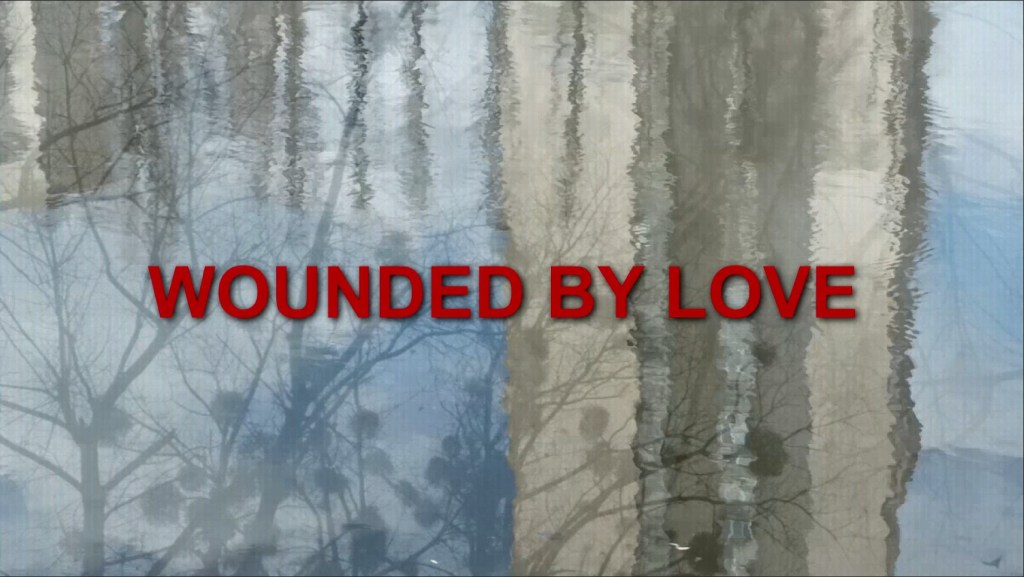
The story with the video was a separate adventure. We here are historically accustomed to perceiving English-language songs as music, since not all of us have a developed skill in perceiving English text by ear. And in a world that produces these English-language songs in huge quantities, few people will listen with bated breath to the lyrics in an unfamiliar language, even the name of which many did not know a couple of years ago. Despite the underground entourage and strange tricks with sound, we still wanted to be understood. And for this it was necessary to make the most accurate translations and present them in the form of lyric videos. One more has been added to the list of super tasks.
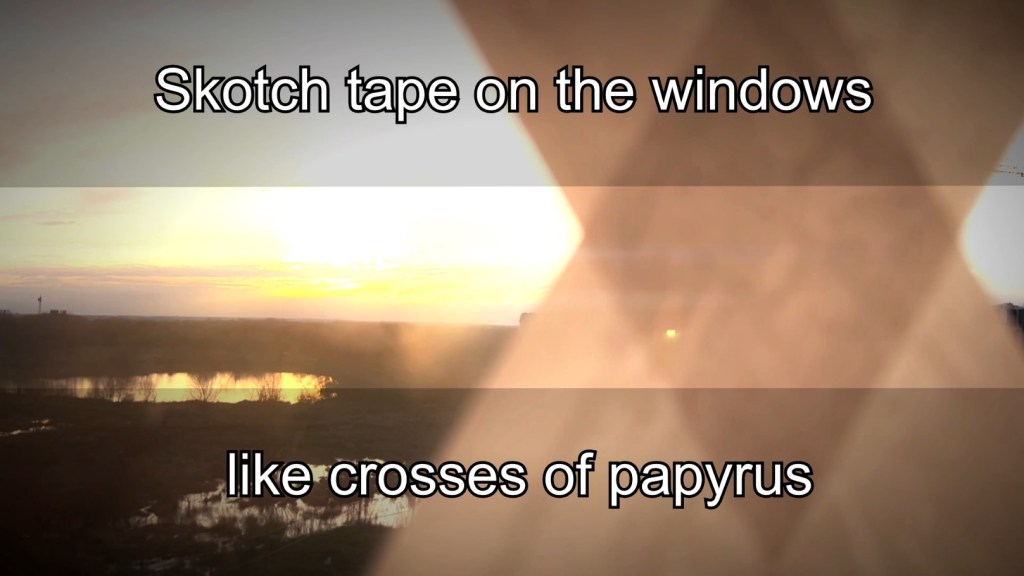
The project had a zero budget, and if there were any super-professionals in video on the team, they preferred to remain in the shadows. Although talented cameramen and editors were all found, and their help was very helpful. To have something to start from, I asked the poets to send any visual materials (preferably their own) that were at least remotely related to the text. So we had at our disposal footage of someone’s favorite cat and favorite swamp, thoughtful wires against the sunset, a gloomy destroyed house, a luxuriating couple in a hospital room, as well as a lot of trees, rivers, monuments and other equally valuable details. The musicians filmed their mysteriously blinking modules and pedal batteries. AI came to the rescue in some cases – where would we be without it?! It seems that working on the video took many more nights than creating the album itself. Not all poets were delighted with the result – one video even had to be deleted in the end – but in fairness, it is worth noting that among the poets who sent their materials, there were no dissatisfied ones.
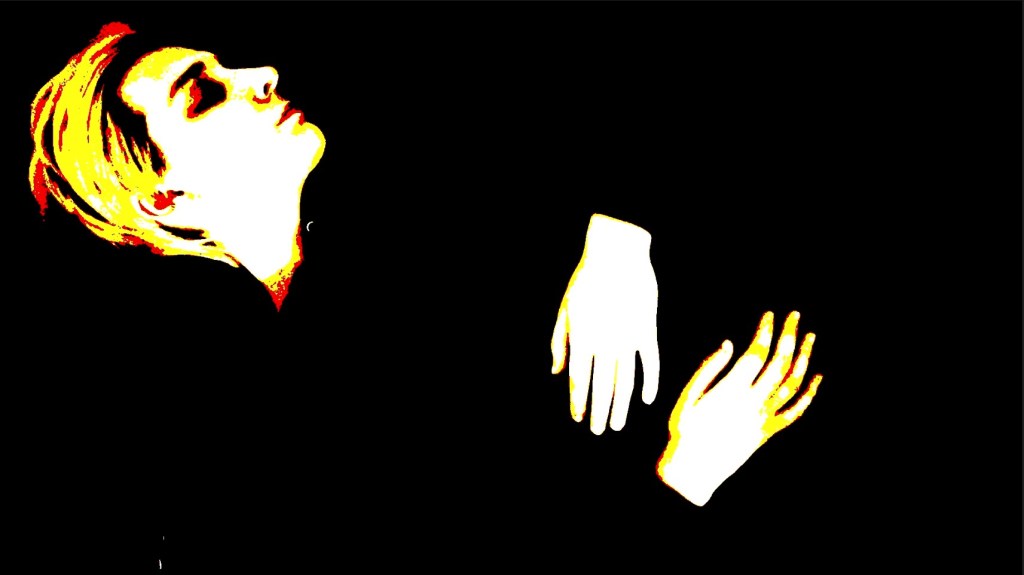
One video was filmed live: it was, relatively speaking, a dance performance based on fairly straightforward but piercing lyrics by Anastasiiith and disturbing, but very harmonious music by TotoTobass..
in the cold winter to warm up not with the body, but with the thoughts,
when you remember what pictures moles draw on the body.
millimeters of beloved flesh, look like a map,
like constellations from the sky drip stars on the skin .
in the middle of the night to huddle in the void, waiting for healing
the soul crippled from separation, tears on the cheeks
they flood and suffocate even worse than the January darkness.
in the empty room she is alone with her demon.
‘Alone with the Demon’ by Anastasiiith
In three hours, a plastic monologue was filmed, or rather a dialogue with the demon of despair and at the same time with a partner fighting at the front. Never in my life I have shot anything like this – and I didn’t even imagine that I would have to. In a couple of months, performer Tori, whose main occupation is a psychologist, will miraculously escape death in the Academy of Decorative and Applied Arts, partially destroyed by rocket fire.
When I said that I will have my own psychological office and millions of dollars will fall on me, that is not what I meant.
Tori Promin, performer
we need no walls nor shadows
our house of sun and wind is
priceless without them
autumn encircles our house with the frost
Is it cold? no,
as there’s wine and poems
And faith – as much as the leaves on the wet floor
and love – as much as the crows on the blue ceiling
so what do we care of these guests
in black boots?
what do we care of these witches,
devils and demons?
we hold our hands tight.
my darlings, hold on,
Just a little bit more, I am sure
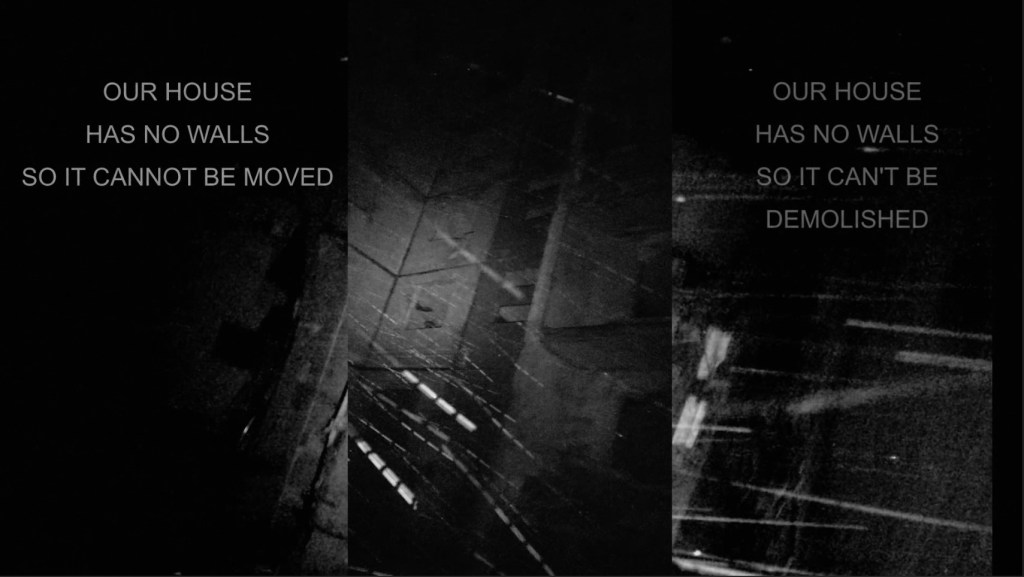
our house has no walls
so it cannot be moved,
our house has no walls
so it can’t be demolished
‘Our House’ by Stepan Penkaliuk
If you think of war as an ultimate act of disregard for human life, the music of “Our House” reflects that on a cerebral level. The base electric cello loops sound as if a giant, unstoppable grinding machine that eats the cities whole, was recorded on a cassette, and this fragile plastic artefact in your hand is the only messenger left to tell the story of the houses that don’t exist anymore. Slow, thumping drum-like sounds were the samples I recorded on a phone during the actual siege of Chernihiv in that hellish Spring of 2022, before I had a chance to escape. I wasn’t able to identify the weapon that made a sound like that.
To this day I sometimes feel like a protagonist of some sick, hallucinogenic nightmare.
I observe bombed residential buildings in my neighborhood, and even if the city is functioning sort of normally, these dead houses make me think that “this could happen to me.
Fedir Tkachov, musician (UA)
All proceeds from the sale of the album on Bandcamp are transferred to the account of the Sister of Mercy Foundation, which supports the Military Medical Clinical Center of the Northern Region, which is located in long-suffering Kharkiv. So far it’s about 400 euros; I dare to hope that readers of this long text and new listeners of the album will add to this amount. This money is critically important now.
I think the overriding impression I have from getting so close to these texts is the resilience they convey in the face of a truly devastating situation. Despite loss, despite material, physical and psychological damage, despite the daunting challenge of facing such a powerful enemy they are a statement of implacable defiance and determination to be free from tyranny.
Guy Richardson, musician (UK)
Dmytro Postovalov aka Bayun the Cat,
musical curator of the project


 MEANS
MEANS 